
Santa Catalina Arch: Antigua Guatemala's Iconic Colonial Landmark
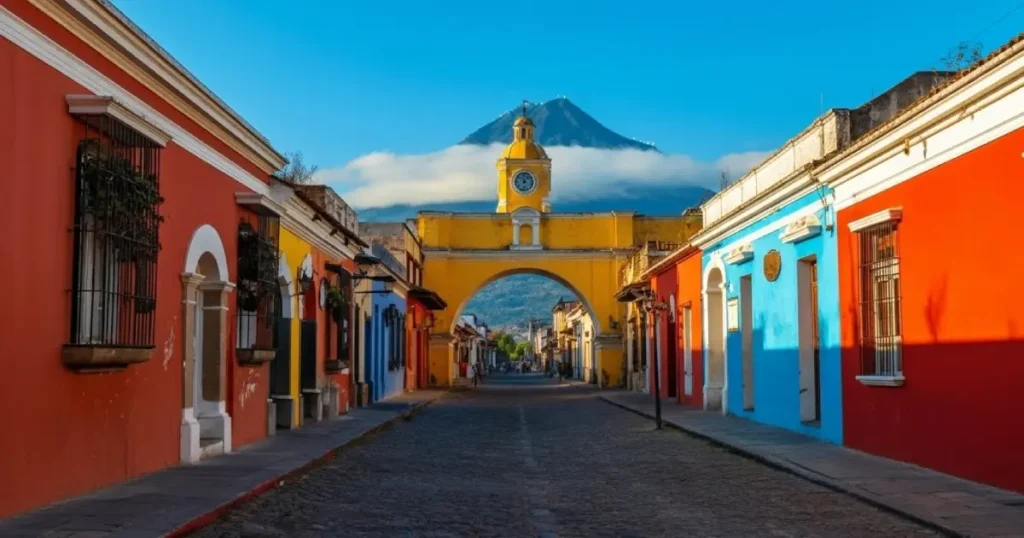
- Santa Catalina Arch & Colonial Landmarks
- Historical and Cultural Background
- The Architecture: Form, Function, and Evolution
- The Iconic View: Framing Volcán de Agua
- Visiting the Santa Catalina Arch: A Practical Guide
- Anthropological and Cultural Significance
- Nearby Attractions
- Santa Catalina Arch in Antigua Guatemala
Santa Catalina Arch & Colonial Landmarks
Few architectural monuments in Central America carry the narrative weight of the Santa Catalina Arch. Rising above the cobblestones of Fifth Avenue North in Antigua Guatemala, this saffron-yellow baroque structure has transcended its original purpose to become the defining visual symbol of one of Latin America's most beautifully preserved colonial cities. What began as a pragmatic solution to a 17th-century religious dilemma has evolved into the most photographed landmark in the country—a testament to the intersection of faith, ingenuity, and resilience.
What makes the Santa Catalina Arch endure is not merely its photogenic qualities—though the sight of Volcán de Agua framed perfectly through its opening is undeniably breathtaking. It is the layered history embedded in every stone: the devotion of the Catalina nuns, the craftsmanship of colonial builders, and the remarkable survival through earthquakes, political upheaval, and the passage of more than three centuries.
Historical and Cultural Background
The Colonial Context of 17th-Century Antigua
To understand the Santa Catalina Arch, one must first understand the religious and social framework of colonial Guatemala. During the late 1600s, Antigua Guatemala—then known as Santiago de los Caballeros—served as the capital of the Captaincy General of Guatemala, a vast territory encompassing much of Central America. The city was a center of Catholic religious life, home to numerous convents, monasteries, and churches that shaped both the physical landscape and the spiritual identity of the region.
The Order of Santa Catalina Martir, named for Saint Catherine of Alexandria, established their convent on what is now Fifth Avenue North. These women had taken solemn vows of enclosure, a practice rooted in medieval monastic tradition that required complete separation from the secular world. The nuns were not merely discouraged from public contact—they were strictly forbidden from being seen by anyone outside their religious community.
The Architectural Dilemma
The problem that gave birth to the arch was fundamentally logistical. The Santa Catalina convent occupied one side of the street, while the Convent of the Virgin—which housed a school where the nuns taught—stood on the opposite side. For the sisters to fulfill their educational mission, they needed to cross a public thoroughfare. Yet doing so would violate their sacred vows of seclusion.
The solution was elegantly practical: construct an elevated enclosed bridge that would allow passage above the street, entirely hidden from the eyes of passersby below. The arch, therefore, was not originally conceived as a monument or decoration. It was religious infrastructure, a physical manifestation of devotion to vows that prioritized spiritual purity over worldly convenience.
Survival Through Catastrophe
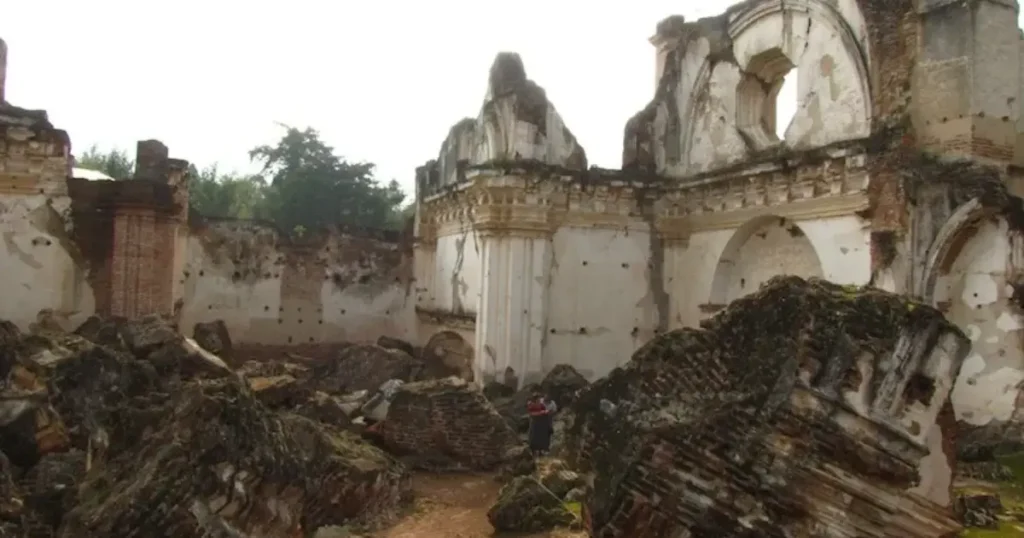
The earthquake of July 29, 1773, known as the Santa Marta earthquake, devastated Antigua Guatemala. The destruction was so complete that Spanish authorities made the controversial decision to relocate the capital to what is now Guatemala City. Churches crumbled, convents collapsed, and much of the colonial architecture was reduced to ruins.
Yet the Santa Catalina Arch remained standing. This survival was not merely structural luck—it became symbolic. As the city's population dwindled and buildings fell into disrepair, the arch endured as a monument to the resilience of both the physical structure and the community that had built it. Its continued existence through subsequent earthquakes, political transitions, and centuries of weathering has cemented its status as a symbol of permanence in a region marked by geological and political volatility.
The Architecture: Form, Function, and Evolution
Original Construction and Design
The arch was constructed using traditional colonial building techniques, with thick masonry walls designed to support the enclosed passageway above. The baroque styling reflects the dominant architectural vocabulary of 17th-century Spanish America, characterized by robust forms and practical ornamentation. The structure spans approximately 15 meters across the street, rising high enough to allow pedestrian and cart traffic to pass freely beneath.
Inside the arch lies the hidden passageway—a covered corridor with small windows that allowed light to enter while preventing anyone below from seeing the nuns as they crossed. This interior space, rarely accessible to modern visitors, remains a testament to the ingenuity of colonial architects who balanced religious requirements with structural necessity.
The French Clock: A 19th-Century Addition
The clock that now defines the arch's silhouette was not part of the original 1690s construction. It was added during the 1830s, during the brief period of the Central American Federation, when Guatemala, along with Honduras, El Salvador, Nicaragua, and Costa Rica, formed a short-lived united republic. The clock reflects French horological design and requires manual winding every three days to maintain accurate time—a task that continues to this day.
This addition transformed the arch from a purely religious structure into a civic landmark. The clock served a practical public function in an era before personal timepieces were common, and its presence elevated the arch's status from convent infrastructure to community monument.
The Signature Saffron Yellow
The arch's distinctive yellow color—variously described as saffron, mustard, or golden ochre—is perhaps its most immediately recognizable feature. This hue was not arbitrary; yellow and terracotta tones were common throughout colonial Antigua, derived from locally available pigments and reflecting Spanish architectural traditions adapted to Central American materials. Against the deep blue of Guatemala's highland skies, the yellow creates a visual contrast that photographers and painters have celebrated for generations.
The Iconic View: Framing Volcán de Agua
A Composition Crafted by Geography
One of the most celebrated aspects of the Santa Catalina Arch is its alignment with Volcán de Agua, the 3,766-meter stratovolcano that dominates Antigua's southern horizon. On clear days, standing at the correct position on Fifth Avenue North, visitors can capture an image where the arch perfectly frames the volcano's symmetrical cone—a composition that appears almost deliberately designed.
This alignment is, in fact, a fortunate accident of urban planning and geography. The colonial street grid of Antigua was laid out according to Spanish town planning conventions, while the volcano's position is purely geological. Yet the result is a visual harmony that has made this view one of the most reproduced images in Central American tourism.
Visiting the Santa Catalina Arch: A Practical Guide
Getting There
The arch is located on Fifth Avenue North (5a Avenida Norte), commonly called Calle del Arco, in the heart of Antigua Guatemala's historic district. From Guatemala City, Antigua is approximately 45 kilometers west, reachable in 1 to 1.5 hours depending on traffic conditions. Shuttle services operate regularly between the two cities, and many hotels in Antigua offer airport transfer arrangements.
Within Antigua itself, the arch is easily accessible on foot from virtually any central accommodation. The city's compact historic core makes walking the most practical transportation method, and the arch serves as a natural orientation point for navigating the colonial center.
Best Times to Visit
Early Morning (6:00–8:00 AM): Optimal for photography, with soft golden light and minimal crowds. Serious photographers often arrive before sunrise to capture the arch as dawn breaks over the volcano.
Mid-Morning to Afternoon: The busiest period, with tourists, vendors, and vehicle traffic creating a lively but crowded atmosphere. The arch's role as a living landmark rather than a museum piece is most evident during these hours.
Late Afternoon (4:00–6:00 PM): Pleasant lighting returns as the sun lowers, though clouds may obscure volcano views. The surrounding cafes fill with visitors enjoying the golden hour ambiance.
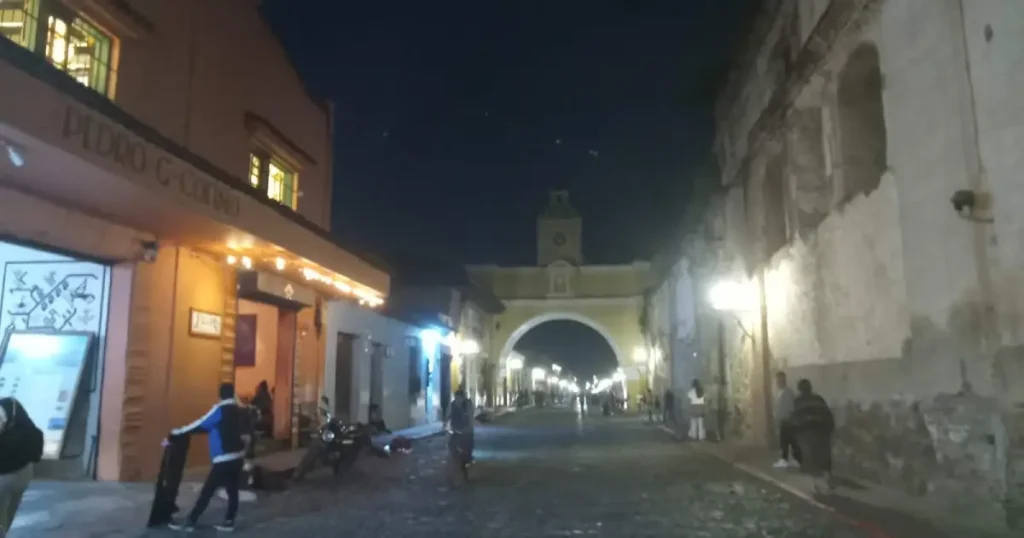
Evening: A romantic and atmospheric time to visit, with streetlights casting warm light on the arch's yellow facade. Restaurants and bars in the surrounding blocks come alive, making this an ideal time to combine arch viewing with dinner plans.
During Semana Santa
Holy Week (Semana Santa) transforms the arch into the centerpiece of Antigua's most significant annual celebration. Elaborate alfombras—carpets made from colored sawdust, flowers, and other materials—cover the streets, and religious processions pass beneath the arch carrying floats depicting scenes from the Passion of Christ. Visiting during this period offers an unparalleled cultural experience, though crowds are at their peak and advance accommodation booking is essential.
Anthropological and Cultural Significance
The Paradox of Visibility
The Santa Catalina Arch embodies a profound irony that speaks to broader questions of public memory and cultural transformation. A structure built explicitly to enable invisibility—to allow women to move through space without being seen—has become the most visible, most photographed, most recognized landmark in the entire country. What was designed for hiddenness is now celebrated for its prominence.
Architectural Influence Beyond Antigua
The Santa Catalina Arch's influence extends beyond its immediate location. The Guatemala Post Office Building in Guatemala City, constructed in the early 20th century, was explicitly designed to evoke the arch's form—a tribute from the new capital to the old. This architectural quotation demonstrates how the arch had already achieved iconic status well before the modern tourism era, serving as a symbol of Guatemalan identity that transcended its original religious function.
Living Heritage vs. Museum Culture
Unlike many historic landmarks that are cordoned off, restored to a frozen moment in time, and presented as museum pieces, the Santa Catalina Arch remains integrated into daily life. Cars pass beneath it, vendors sell goods in its shadow, and residents use Fifth Avenue North as a regular thoroughfare. This integration preserves the arch's character as a functional urban element rather than a static monument, though it also creates ongoing preservation challenges as modern traffic and commercial activity stress the historic structure.
Nearby Attractions
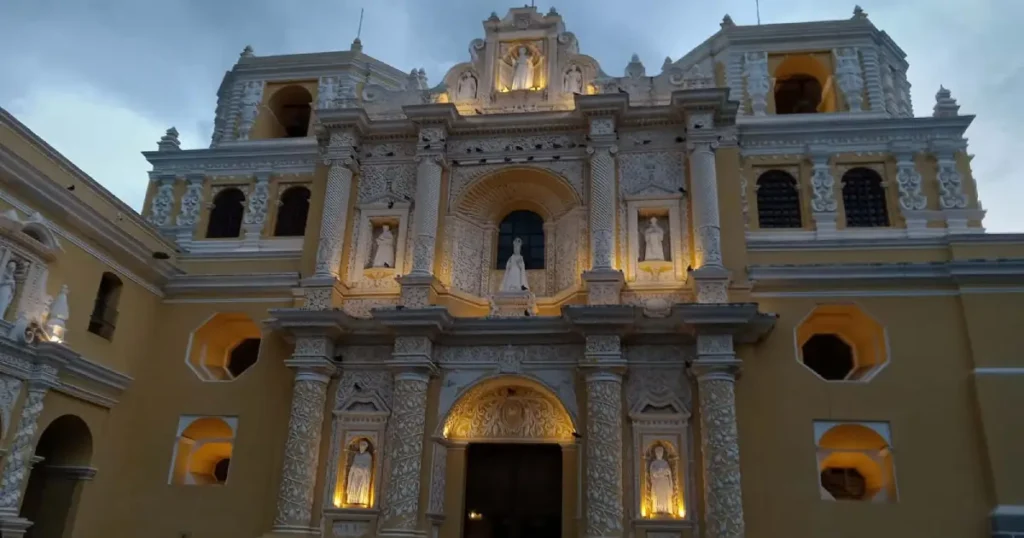
La Merced Church
Located a short walk from the arch, La Merced Church (Iglesia de La Merced) represents another pinnacle of Antiguan baroque architecture. Its yellow-and-white facade features intricate stucco ornamentation, and its peaceful courtyard with central fountain offers respite from the busier streets. The church's roof terrace, accessible for a small fee, provides panoramic views of the city and surrounding volcanoes.
Central Park and Cathedral
Antigua's Central Park (Parque Central) serves as the city's main plaza, anchored by the partially ruined Cathedral of Santiago. The cathedral's colonial grandeur, though diminished by earthquake damage, remains impressive, and the surrounding park is the social heart of the city, particularly on weekend evenings when local families gather.
Convento de las Capuchinas
This former convent complex offers insight into colonial religious life, with well-preserved cloisters, cells, and an unusual circular tower containing individual meditation chambers. The site provides important context for understanding the monastic world that gave rise to the Santa Catalina Arch.
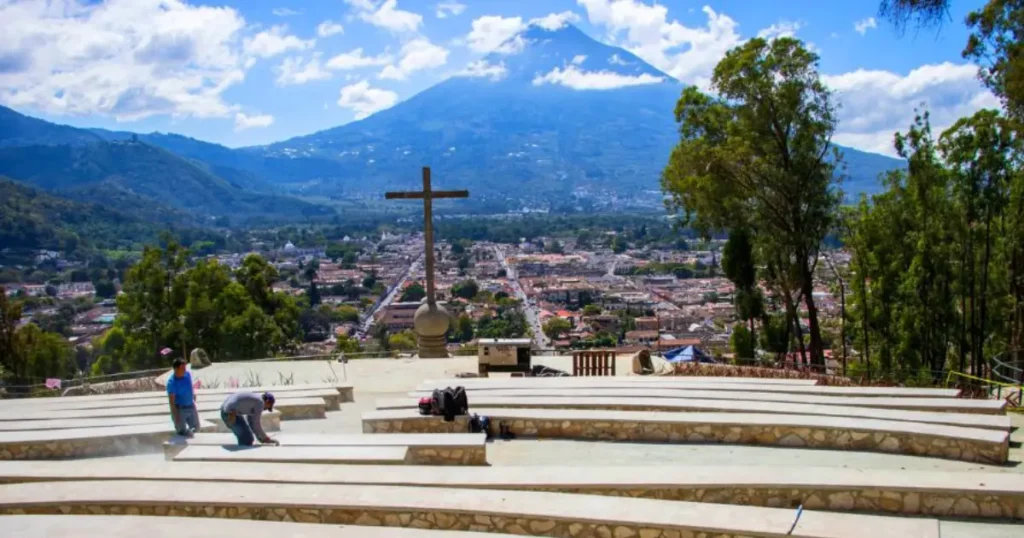
Cerro de la Cruz
For visitors seeking elevated views, Cerro de la Cruz (Hill of the Cross) offers a panoramic vantage point overlooking the entire city with all three surrounding volcanoes visible on clear days. The hike is short but steep, and early morning visits offer the best visibility.
Santa Catalina Arch in Antigua Guatemala
The Santa Catalina Arch stands as far more than a photogenic landmark or a convenient symbol for tourism brochures. It is a physical embodiment of colonial religious devotion, architectural ingenuity, and remarkable historical endurance. From its origins as a hidden passageway serving cloistered nuns to its current status as the most recognizable structure in Guatemala, the arch has accumulated layers of meaning that reward thoughtful engagement.
The arch endures not because it was built to last—though its survival through earthquakes and centuries of weathering is remarkable—but because it continues to matter. It remains relevant, beloved, and central to Antigua's identity. In a world where so many historic structures exist only as relics of the past, the Santa Catalina Arch remains vibrantly present, a bridge not only across a colonial street but across time itself.